- Details
- Written by: Ray Oltion
- Category: Writing
- Hits: 245
Dissatisfaction
Imagine traveling thousands of miles through dangerous territory to reach what you thought was paradise, only to discover that you brought all your problems with you, and faced new problems at your destination. How would you feel? Would you become bitter and condemn your new surroundings as unwelcoming, brutal, and predatory? Would you long for the home you left behind, the friends and family that you would probably never see again?
Such is the story of many immigrants to other countries, those shining havens of freedom and light to which many disaffected people have flocked over modern history. Maybe humanity evolved to wander and expand into new territory, or perhaps the success of the species simply created pressure due to overpopulation and diminished resources that pushed those less fortunate to move. Whatever the cause, this displacement of people to other lands invariably creates friction between the established occupants of the new land and its novel immigrants, often to the point of disrupting both indigenous populations and newcomers.
Such is the story of present day immigrants to the United States, as depicted in Christina Henriquez’s novel The Book of Unknown Americans. This book collects the short histories of several supporting characters and longer first person accounts of principal characters to illuminate a community of immigrants in Wilmington, Delaware: mothers, fathers, and children. It attempts to put the reader in those people’s predicaments through their life stories, set against a backdrop of economic decline of the post 2008 financial crisis.
Henriquez pairs these two forms of disruption, social and economic, to heighten the tension of her plot. This presages the current climate, where political aspirants mine these disruptions for angst to fuel their careers. Currently, some citizens of the United States express their frustration by singling out immigrants as the cause of their many woes. This diffused form of scapegoating offers simple solutions to complex problems: build a wall, send them home, or lock them up. This age-old tactic tends to polarize the populace, gathering those in favor or those opposed to such rhetoric into easily manipulated groups.
- Details
- Written by: Ray Oltion
- Category: Writing
- Hits: 968
Stories
Who doesn’t like a good story? If we were lucky, our parents read to us when we were young, and we grew up enchanted by the world of imagination and its creatures. This experience demonstrated to us the power of ideas, and the extension of ourselves in the characters we love and hate. Before we assume the burdens of adult roles, we can invent our own stories, fill them with heroes and villains, and embark upon adventures.
Even as grown-ups we crave stories. Newspapers provide not facts, but stories. Friends tell us their stories of their marriages, careers, travels, and battles. Listening to those stories enfolds our imaginative selves into the other person’s life, letting us see the world through their eyes. As such, this empathetic state strengthens the social bonds that draws people together in times of need.
Stories may teach the reader certain truths, but they do so in a respectful and circumspect manner. They do not preach to us but let us draw our own conclusions from the outcome, and reinforce the message not with threats but with deeply felt emotions. They are an older and more powerful form of social discourse and nurture than deities or doctrines.
In our times of tribulation, suffering as we are from inhuman forces deployed for the sake of power and wealth, we can turn to stories not only for comfort, but for contemplation. The characters may work through problems that we ourselves encounter, and emerge either successful or defeated. By following their feelings and decisions, we try out those same scenarios in our own situation, as a simulation removed from our actual circumstances.
When a society encounters sweeping conundrums that defy conventional solutions, people may act irrationally and tilt social norms even further from the stable axis, causing dangerous and more dramatic gyrations that threaten the very structure of society. This is when stories can help restore the center, as they reveal the relationships and mechanisms of power and influence, giving the individual time to think and return to rationality. We can contemplate the ultimate consequences of our collective actions, and perhaps avert disaster when the collective veers off the path of sanity.
If civilization does collapse and humanity destroys itself, it will be ironic that we began by telling stories, and finished the story of humanity with more stories. We can look at it more optimistically if we realize that telling stories helped birth civilization, and may also aid in its rebirth. The stakes could not be higher. Listen well, my children, for I have a story to tell.
- Details
- Written by: Ray Oltion
- Category: Writing
- Hits: 2516
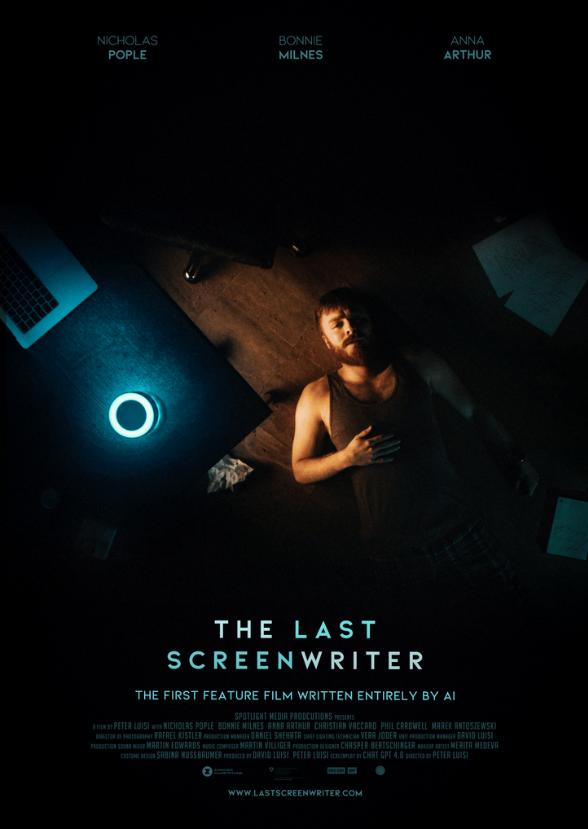
Redshark News wrote a short article about this film, which uses AI via ChatGPT to generate an entire screenplay. A director and his movie producing team filmed it and it is available in full on the Internet. The trailer gives you an idea of how the movie works.
This seems incredible. At first I thought it was another AI science fiction film, but no, it actually was created by an AI. Ironically, the plot of the movie mirrors the director's prompt to the AI that actually created the screenplay. Arguably, the director's input is what made the film, not the screenplay. None of the scenes and dialog were changed from the AI script, though.
Of course, this makes me wonder if, for my Tennyson story, I could load all the characters, themes, plot, and scenes into an AI and have it do all the grunt work of writing. I doubt it would turn out like it would if I had written it myself, mainly because I would think of more nuances while writing which would direct the development. Still, when writing to an outline, it might be close. The AI would probably make choices similar to what I would during the writing process.
Then again, what is the purpose of writing? I am not interested in publishing, so why have an AI take my ideas and run with it? It seems lazy, and maybe if I don't like the writing part, I shouldn't be doing it at all. Still, it may be fascinating to see my ideas come to life, whether it is published or not.
Maybe it could be a co-writing relationship. One of the latest books I read on the subject, The new breed: what our history with animals reveals about our future with robots, by Kate Darling, suggested that all the fear about AI replacing human endeavor is misplaced. The author proposes that a more productive view is that AI will be similar to animal helpers we have used for ages. Their strong points augment our not so strong points, and together the combination is greater than the sum of the parts.
So imagine working with an AI to generate text and dialog, and reworking the rough draft to mold it to your own tastes. It could be an iterative process, one that capitalizes on the strengths of each participant. Call it an assistant, a super word processor, a ghost writer, whatever, but the point would be to enhance the writer's experience and remove some of the obstacles.
Of course, there has been a backlash from the creative community since the film was released on July 5th. People are concerned that ChatGPT may have trained the AI with copyrighted movies and scripts. While this doesn't seem like copyright infringement to me, many who feel threatened by this think otherwise.
After all, how does a writer educate him/herself? Reading tons of books and watching gobs of movies fills the writer's mind with examples and images. Is it copyright infringement if the writer produces something new from all that mashup of experience? Of course, the writer has injected his/her own experience and understanding into the process, so it is transmuted, digested, and reconstituted in a new form. You could argue that an AI cannot do that. Therefore, an AI generated manuscript is more like a chopped salad than a baked casserole.